By Jeremy T. Ballreich
DETROIT — The silence inside Ford Field was deafening.
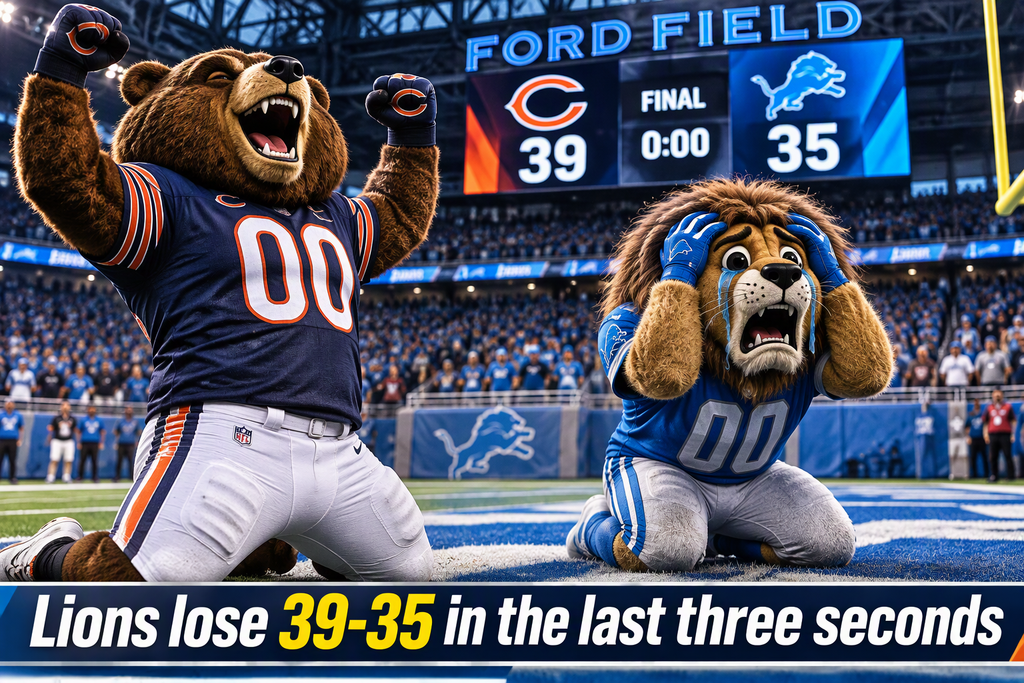
More than 65,000 Detroit Lions fans stood frozen Thursday afternoon as the final seconds disappeared from the scoreboard. A Thanksgiving celebration that seemed inevitable for nearly three hours suddenly turned into disbelief as the Chicago Bears completed a shocking late comeback to defeat Detroit 39-35.
For 59 minutes and 57 seconds, the Lions held the lead.
For the final three seconds, the Bears did.
And those three seconds were enough.
In one of the most stunning finishes in recent NFC North history, Chicago scored the game-winning touchdown with just seconds remaining, turning what appeared destined to be another memorable holiday victory into one of the most painful losses of the Dan Campbell era.
Thanksgiving Atmosphere Turns to Shock
Ford Field carried a playoff-like atmosphere long before kickoff.
Honolulu Blue filled every section of the stadium as fans arrived expecting another statement victory from one of the NFC’s premier teams. The energy never faded throughout the afternoon, as Detroit repeatedly answered every challenge Chicago presented.
When the Bears scored, the Lions responded.
When Chicago threatened momentum, Detroit regained control.
For most of the game, the Lions looked like the better team.
They never trailed.
That reality is what made the final result so difficult to comprehend.
Offense Produces More Than Enough
Scoring 35 points at home typically results in a victory.
The Lions’ offense did its job.
Detroit consistently moved the football, generated explosive plays, and produced scoring drives when opportunities were available. The offensive line delivered in key moments, the rushing attack controlled stretches of the game, and the passing game made timely plays when needed.
Yet despite Detroit’s offensive success, Chicago never allowed the game to get out of reach.
Every Lions surge was met with a Bears response.
Detroit maintained control.
Chicago remained within striking distance.
That distinction ultimately defined the afternoon.
Jahmyr Gibbs Delivers a Historic Performance
One of the brightest moments of the game came from running back Jahmyr Gibbs, who delivered a performance worthy of national attention.
Gibbs finished with:
21 carries
205 rushing yards
3 rushing touchdowns
4 receptions
41 receiving yards
His combined totals of 246 yards from scrimmage and three touchdowns helped fuel Detroit’s offense throughout the day and strengthened his growing case as one of the league’s most dynamic offensive players.
If MVP conversations continue into December, Gibbs has certainly earned consideration.
Ford Field Believed Victory Was Secure
As the fourth quarter unfolded, Ford Field fully embraced what appeared to be another Detroit win.
Every first down generated cheers. Every defensive stop felt significant. Every second that disappeared from the clock seemed to bring the Lions closer to securing a divisional victory.
Fans discussed playoff positioning.
They discussed postseason seeding.
They discussed another signature win.
Why wouldn’t they?
Detroit had led from the opening quarter through the final minutes.
What nobody realized was that Chicago only needed one lead all afternoon.
The Drive That Changed Everything
Then came the final possession.
With time running out, the Bears faced what appeared to be their final opportunity.
Detroit needed only one defensive stop to close the game.
Instead, Chicago found life.
The Bears methodically advanced down the field, connecting on critical passes and steadily increasing pressure on a Detroit defense tasked with protecting a narrow lead.
The atmosphere inside Ford Field shifted from celebration to nervous anticipation.
Every snap suddenly carried enormous significance.
The Lions remained in front.
But the margin for error had vanished.
Three Seconds
Some moments in sports feel impossible even while they are happening.
This was one of them.
With just three seconds remaining, Bears quarterback Caleb Williams connected with wide receiver Rome Odunze for the go-ahead touchdown in the back corner of the end zone.
For the first time all afternoon, Chicago held the lead.
Ford Field fell silent.
The emotional swing was immediate and overwhelming.
Moments earlier, fans were anticipating victory.
Seconds later, they were staring at the scoreboard in disbelief.
Players remained motionless.
Coaches searched for answers.
The reality was difficult to process.
The Lions had just lost a game they led for 59 minutes and 57 seconds.
NFL Cruelty on Display
The NFL has a unique way of delivering heartbreak.
Statistics, time of possession, momentum, and game flow often shape the narrative. Yet none of those factors determine the outcome.
Only the final score matters.
Detroit played well enough to win.
The numbers suggest it.
The eye test suggests it.
The lead tracker certainly suggests it.
But football does not reward teams for leading the longest.
It rewards teams for leading when the clock reaches zero.
The Bears accomplished that.
The Lions did not.
Questions That Will Linger
In the days ahead, Detroit will undoubtedly examine every detail of the game’s closing moments.
Could the offense have secured one more first down?
Could the defense have produced one more stop?
Could better clock management have prevented Chicago’s final opportunity?
Heartbreaking losses inevitably create endless what-ifs.
One play.
One tackle.
One decision.
Any of them might have changed the outcome.
Instead, Detroit is left wondering how a game it controlled for nearly 60 minutes slipped away in the final three seconds.
Looking Ahead
One game does not define a season.
The Lions remain among the NFL’s elite teams and continue to possess one of the league’s most talented rosters. Their goals remain firmly intact.
However, championship contenders learn valuable lessons from losses like this.
They learn how to finish.
They learn how to close games.
They learn how to protect leads when victory appears certain.
Dan Campbell’s team now faces that challenge.
Final Whistle
Years from now, many will remember only the score:
Chicago 39, Detroit 35.
But that score tells only part of the story.
It does not capture the confidence inside Ford Field.
It does not reflect Detroit’s control throughout most of the afternoon.
And it cannot fully explain the disbelief that swept through the stadium after the final touchdown.
What history will remember is simple:
The Detroit Lions led for 59 minutes and 57 seconds.
The Chicago Bears led for three.
Those three seconds changed everything.