By: Jeremy T. Ballreich
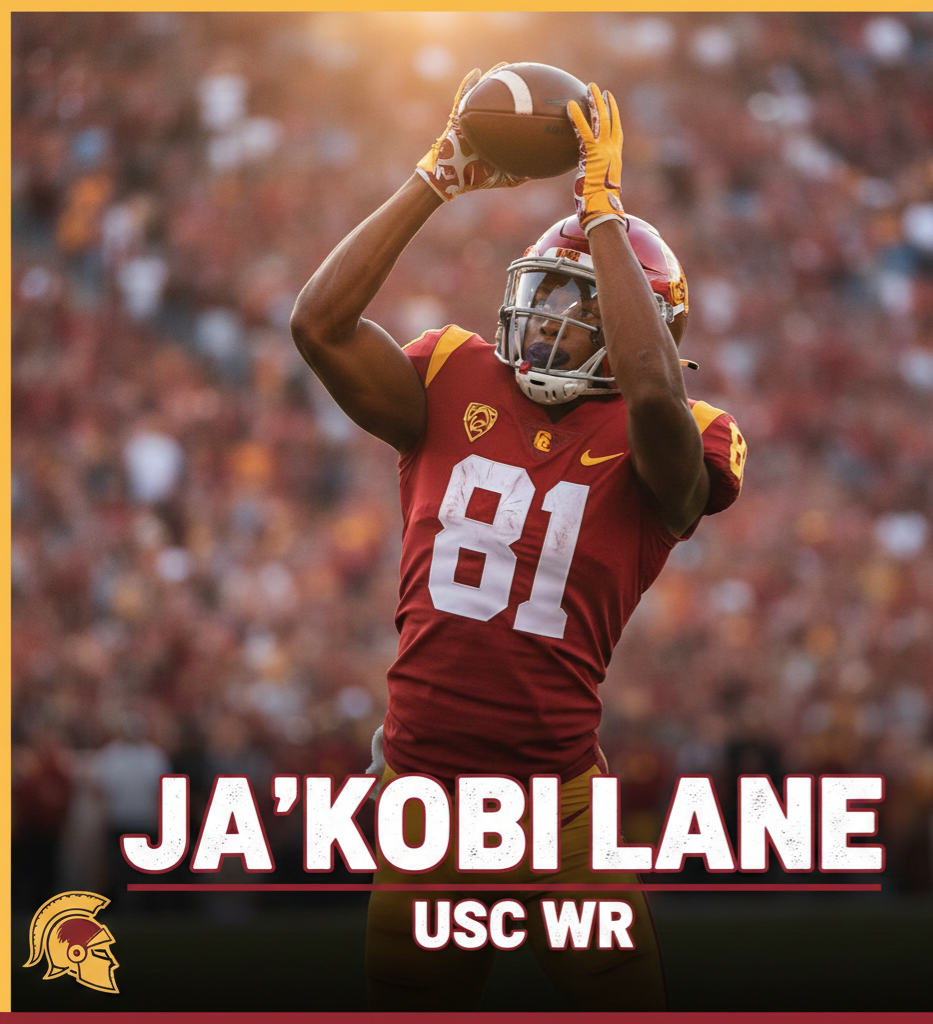
Few wide receivers in the 2026 NFL Draft class have taken a more fascinating developmental arc than Ja’Kobi Lane, the long‑striding, high‑point specialist who blossomed into one of USC’s most reliable perimeter weapons. At 6’4” and roughly 200 pounds, Lane brings a prototype frame, natural ball skills, and a red‑zone presence that jumps off the screen. But what makes him compelling isn’t just the size — it’s the way he weaponizes it.
Lane arrived at USC as a tall, wiry, high‑ceiling athlete out of Mesa, Arizona, where he dominated at Red Mountain High School and earned wide receiver MVP honors at the 2022 Elite 11. He was known for circus catches, body control, and a catch radius that made quarterbacks look better than they were. But he was also raw — a long‑term projection rather than a plug‑and‑play freshman star.
That projection paid off. By the time he declared for the 2026 NFL Draft, Lane had stacked back‑to‑back productive seasons, including 49 receptions for 745 yards and four touchdowns in 2025, averaging 15.2 yards per catch. He became a trusted outside target in USC’s offense, thriving as an X‑receiver who could win vertically, win through contact, and win late in the down when plays broke down.
Lane’s game starts with his frame. At 6’4” with 10⅜‑inch hands and 32⅝‑inch arms, he’s built like a classic boundary receiver. His catch radius is enormous, and he consistently plays above the rim. When USC needed a bailout throw — a back‑shoulder fade, a sideline isolation shot, or a contested red‑zone target — Lane was the guy. He’s comfortable catching through contact, shielding defenders with his body, and adjusting mid‑air to off‑platform throws.
But Lane isn’t just a jump‑ball merchant. His 4.55 speed isn’t blazing, but it’s functional and deceptive because of his stride length. Once he opens up, he eats cushion quickly and forces corners to turn their hips earlier than they want to. He’s particularly effective on deep posts, slot fades, and boundary go routes — routes that allow him to build speed and track the ball over his shoulder.
His ball tracking is one of his best traits. Lane consistently finds the football early, adjusts his stride, and positions himself to win at the catch point. It’s a skill that separates true outside receivers from athletes playing the position. He’s also a natural hands catcher — he doesn’t fight the ball, doesn’t let it into his chest unnecessarily, and rarely double‑catches.
Lane’s development as a route runner is where his growth is most evident. Early in his career, he relied heavily on size and natural ability. By 2025, he had added nuance: pacing, stride manipulation, and improved footwork at the top of routes. He’s not a sudden separator — his game isn’t built on twitch — but he understands how to create leverage, how to stack defenders, and how to win late with physicality.
His production reflects that evolution. Across two seasons, Lane scored 16 touchdowns, becoming one of USC’s most consistent scoring threats. He also showed up in big moments, including a strong showing at the Senior Bowl, where he reportedly boosted his draft stock by proving he could separate against NFL‑caliber corners and win in contested situations. Scouts left Mobile talking less about what he couldn’t do and more about how his traits translate to Sundays.
Still, Lane is not a finished product. His release package needs refinement — bigger corners can disrupt him early in the rep, and he’ll need to diversify his hand usage to avoid being stalled at the line. His long‑strider build means he’s not going to snap off sharp-breaking routes with the same suddenness as smaller receivers. He’s more of a vertical and intermediate threat than a short‑area separator.
Additionally, Lane must continue to add functional strength. At around 200 pounds, he’s lean for his height, and NFL defensive backs will test his play strength on every rep. He’s competitive as a blocker but inconsistent — the effort is there, but the technique needs polish.
Despite those areas for growth, Lane’s upside is undeniable. He projects as a Day 2 receiver with a clear role: an outside X who can stretch the field, win contested catches, and provide red‑zone value from day one. His floor is that of a rotational boundary receiver; his ceiling is a matchup‑problem WR2 who can dominate in the air and punish single coverage.
Lane fits best in offenses that value size on the perimeter and push the ball vertically — systems that use layered route concepts, play‑action shots, and isolation opportunities. He’s the type of receiver who makes life easier for quarterbacks who trust their arm talent.
Projection: Round 2–3 Role: Outside X‑receiver; vertical threat and contested‑catch specialist Best Fits: Teams needing size and ball skills on the perimeter; offenses built around play‑action and intermediate/deep passing concepts
Ja’Kobi Lane isn’t the flashiest receiver in the class, but he’s one of the most intriguing. He’s long, he’s fluid, he’s reliable, and he’s still ascending. For the right team, he could become one of the steals of the 2026 draft — a long‑levered playmaker whose best football is still ahead of him.