By: Jeremy T. Ballreich
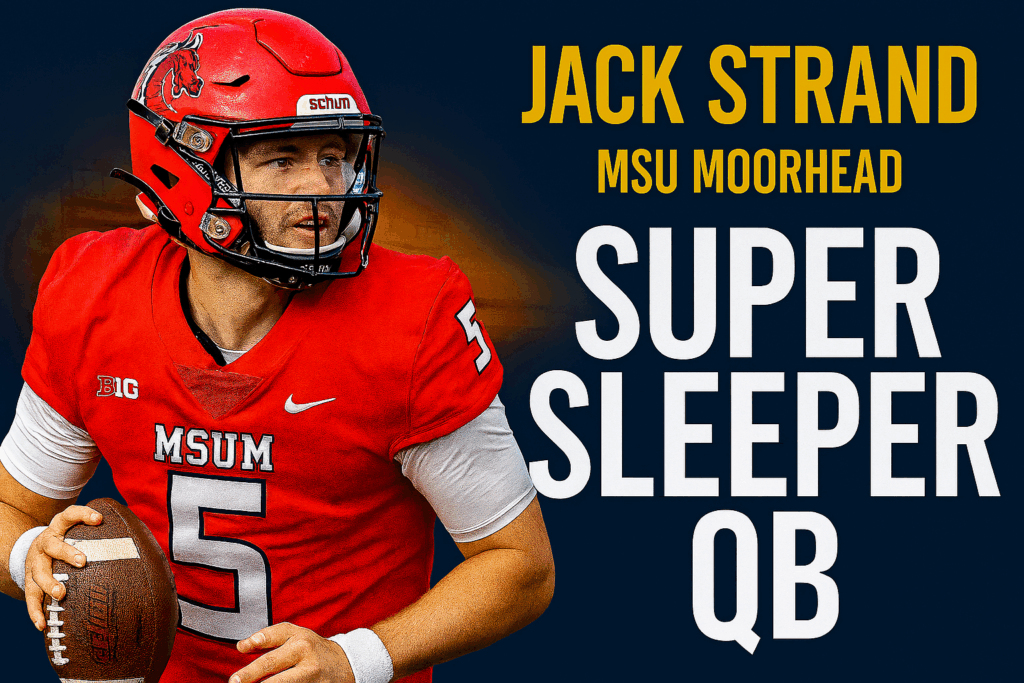
Few quarterbacks in Division II football have rewritten a program’s identity the way Jack Strand has at Minnesota State–Moorhead. A multi-year starter with elite production, advanced processing, and a competitive edge that permeates the Dragons’ offense, Strand enters the NFL Draft cycle as one of the most intriguing small‑school passers in the class. He’s not the prototype in terms of size or arm strength, but his command, accuracy, and football IQ give him a legitimate pathway to an NFL roster — and potentially a long-term role as a high-end backup with developmental upside.
Strand’s résumé begins with volume and efficiency. He shattered MSUM passing records, stacking up yardage and touchdowns at a pace unmatched in program history. But the raw numbers only tell part of the story. What stands out on film is how he elevates the structure of the offense. Strand plays with a rhythmic, timing‑based approach that mirrors the modern NFL’s emphasis on quick-game precision and progression-based reads. He’s a distributor by nature, but not a caretaker — he’s aggressive when the coverage dictates it, and he consistently attacks leverage with anticipation.
At 6’5” and roughly 240 pounds, Strand does have the prototypical frame of an NFL starter, and that will be a sticking point for some evaluators. His arm is adequate rather than explosive, and he’s more functional than dynamic as an athlete. But what he lacks in raw tools, he compensates for with polish, processing, and a deep understanding of how to manipulate defenses.
Strand’s best trait is his mental acuity. He diagnoses coverages pre-snap with veteran calm, frequently adjusting protections, identifying pressure indicators, and aligning his receivers to exploit soft spots. Post-snap, he’s decisive. His eyes are disciplined, his feet are tied to his reads, and he rarely drifts into unnecessary chaos. Strand thrives in full-field progression concepts, showing the ability to work from one to two to three without panic or wasted motion. That’s a trait many FBS quarterbacks struggle to master, and it’s a major selling point for his NFL projection.
Accuracy is another defining strength. Strand throws a catchable, well‑paced ball at all three levels. His short-area placement is excellent — he consistently puts the ball on the upfield shoulder, away from leverage, or into stride to maximize yards after the catch. On intermediate throws, he shows the ability to layer the ball over underneath defenders and in front of safeties. While his deep ball lacks elite velocity, he compensates with timing and trajectory, often releasing early to give his receivers a chance to stack defenders.
Mechanically, Strand is clean and consistent. His base is balanced, his release is compact, and he maintains strong posture in the pocket. He’s not immune to pressure — like most quarterbacks, interior disruption can shrink his throwing windows — but he handles it with poise. He climbs the pocket well, resets efficiently, and rarely sacrifices structure for unnecessary improvisation. When he does escape, he’s capable of extending plays and throwing accurately on the move, though he’s not a true dual-threat.
One of the more underrated aspects of Strand’s game is his competitiveness. He’s a tone-setter for MSU-M, a quarterback who plays with visible confidence and command. Teammates respond to him. Coaches trust him. He’s the type of player who takes ownership of the offense, and that leadership quality will resonate in NFL meeting rooms.
Of course, the jump from Division II to the NFL is steep. Strand will face questions about the level of competition, the speed of the game, and whether his physical ceiling is high enough to survive in a league full of elite athletes. He’ll need to prove he can drive the ball outside the numbers against NFL‑caliber corners, operate under heavier pressure, and maintain his timing when windows close faster than anything he saw in the NSIC.
But small‑school quarterbacks with Strand’s processing ability and accuracy tend to stick in the league. He profiles similarly to past DII and FCS passers who carved out long careers as backups, spot starters, or system fits in timing‑based offenses. Teams that value intelligence, rhythm passing, and operational consistency — think West Coast‑leaning schemes — will see a lot to like.
Projection: Late Day 3 to Priority UDFA
Role: High-end developmental backup with potential to become a low-end starter in the right system. Scheme Fits: West Coast, spread timing offenses, RPO-heavy, and playaction structures.
Jack Strand may not be the loudest name in the class, but he’s the type of quarterback evaluators appreciate the more they study him. He’s polished, poised, and productive — a small-school passer with big-league intangibles.
Knee Cap Biting With The Motor City Lions – YouTube